

Domenico Fargnoli
The public does not have the correct perception of the psychiatric emergency involving Italy which has ties to a more general situation.
Writes Amanda Pustilnik (University of Maryland)
“Today, our largest psychiatric hospitals are prisons. (…) The state prisons spend about $ 5 billion to incarcerate inmates suffering from mental illness, who are not violent. According to the Justice Department 1.3 million individuals with mental illness are incarcerated in state prisons and federal compared with just 70,000 people assisted in psychiatric hospitals ”
Someone will be put in jail just for mental symptoms and for disturbing public order and not because he has committed criminal offenses. In July 2004, The House on Comitte Governement Reform has published a study which found that children are incarcerated in the U.S. (including seven years old ) with serious mental illness but not responsible for criminal conduct.
Compared to the Enlightenment ideals that inspired the U.S. Constitution the above situation is paradoxical for the disappearance of the fundamental distinction made by Pinel during the French Revolution: the mentally ill were separated by criminals and freed from the chains. Thus was born a new branch of medicine, psychiatry.
At a distance of more than two centuries we see a reversal of the trend and a return to confusion between crime and insanity, to prevalence of the logic of segregation and punishment. The return to old guidelines is due to the social significance that has taken the disease conceived as a guilty failure, a lack of control and sense of personal responsibility. It ‘s the old Christian idea of madness as demonic influence, such as complicity with evil, which reappears in a secularized form.
From the religious mentality comes the punitive approach that has prevailed in the U.S., to mental illness. The punishment should reinforce adherence to ‘ethics on which is founded the society and to ensure, by the severity of a penalty, respect for the rules. For the punitive moralistic conception people with mental illness have defects of will or character that make them incapable of controlling: impose restrictive criteria would help to achieve acceptable behavior and increase the sense of responsibility.
The judge replaces the psychiatrist because the latter considering diseases “disturbs” or questionable diagnostic conventions, cannot give certain criteria of not imputability. Therefore being mentally “ill” usually does not guarantee, in the U.S., the impunity with respect to violent crimes.
In Europe Anders Breivik was declared sane with DSMIV diagnostic criteria in a trial in which there has been the tendency to punishment rather than care.
And in Italy? The case of Erika and Omar in Novi Ligure, of Franzoni in Cogne or killers spouses in Erba were dominated by a punitive logic unrelated to psychiatry.
Why are we in front of this trend?
Prof. Amanda C. Pustilink does not clarify the essential point that the role played by psychiatric institutions in allowing the moralistic-punitive model of mental illness is affirmed: one hundred years of Freudianism in America have left their mark. Just in the U.S., however, medias reported the failure of psychoanalysis and biological psychiatry , successor to Freudianism, prepares for a resounding “disaster”, due to the lack of science, with the new edition of DSMV in May 2013.
American doctors are committed to delivering drugs to a ever-growing population of ‘normal’subjects, using diagnoses that seem ad hoc to further the interests of pharmaceutical companies. The most serious cases are subjected to therapies such as iloperidone taken by Adam Lanza, author of the massacre of Newport, which can amplify the tendency to violence. The prisons act as containers for all sorts of mental illnesses that, in a regime of unprecedented violence and perversion, suffer an aggravation. The effects are devastating on the individual and on society. In Italy, the birthplace of Cesare Beccaria who wanted the penalty rationally commensurate to the crime and was against torture, we are experiencing something similar to what happens in the U.S: the operational diagnostic models, the abuse of drugs, the use of ECT, damages the credibility of psychiatry and promotes the success of the moralistic model of mental illness. Since doctors are incapable of preventing and treating mental illness management is the responsibility of the latter, the judges and the courts. The law Orsini-Basaglia drained of the asylums about one hundred thousand patients in recent decades, but at the same time, it filled in a unlikely manner prisons.
There’s an psychiatric emergency within the prisons : according to an epidemiological survey of the Regional Agency of Health prisoners with “psychiatric disorders” are 1137, 33.4% in Tuscany alone. The prison works as a container for mental illness, which is not treated in the circuit of mental health services. With the closure of the asylums were not always created alternative structures so many people are left without control or safety net and ended up in the net of justice. Prisons are infernal. Take over the idea of ruin, the emotional void, humiliation and the ‘marginalization. The psychopathological forms are structured in chronic diseases, difficult to treat. Sexual identity in a context of violence and forced overcrowding, often undergoes a irreversible deconstruction.
Suicide is a dramatic and the frequency, even more than twenty times the norm, is directly related to overcrowding and abuse. How to deal with this situation? On March 31, following the law Marino is expected to close the OPG: the event has a strong symbolic meaning even if people interested are 1400, out of a total of 66,721 Italian prisoners. The OPG have been the emblem of institutional schizophrenia: individuals with total or partial defect of the mind were subjected to a prison regime in unimaginable poor conditions Not to mention the psychological and physical torture.It is ‘necessary that the closure of OPG may be an opportunity not only to propose alternative structures for intervention but an afterthought of psychiatry as a whole. Andrea Zampi, the murderer-suicide in Perugia was submitted last year in Pisa two cycles of 8 TEC: a “therapeutic intervention ” or a practice without any scientific basis that has aggravated the patient’s condition? Today, psychiatrists do not have the necessary expertise to deal with psychosis with the method of psychotherapy: the drug or the ETC are ineffective and dangerous in the long run. Psychiatry must then make a cultural leap and methodological equipping of new scientific and educational criteria. The experience of ‘Collective Analysis which belongs to the theory of the birth of Massimo Fagioli, is a pilot, almost forty years of care, training and research unique attended by thousands of people and hundreds of psychiatrists, committed to deepening the understanding of psychic reality beyond the biological reductionism and the morality of reason and religion. Pannitteri Adriana writes in “La pazzia dimenticata ” (L’asino d’oro 2013) ”
<< (…) Mental illness can not be solved simply by throwing down the walls of asylums, but in a more solid way trying to find out what’s inside the psyche of those who are sick >>
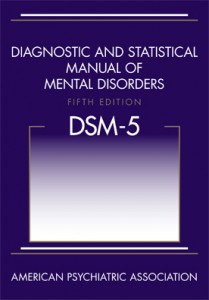









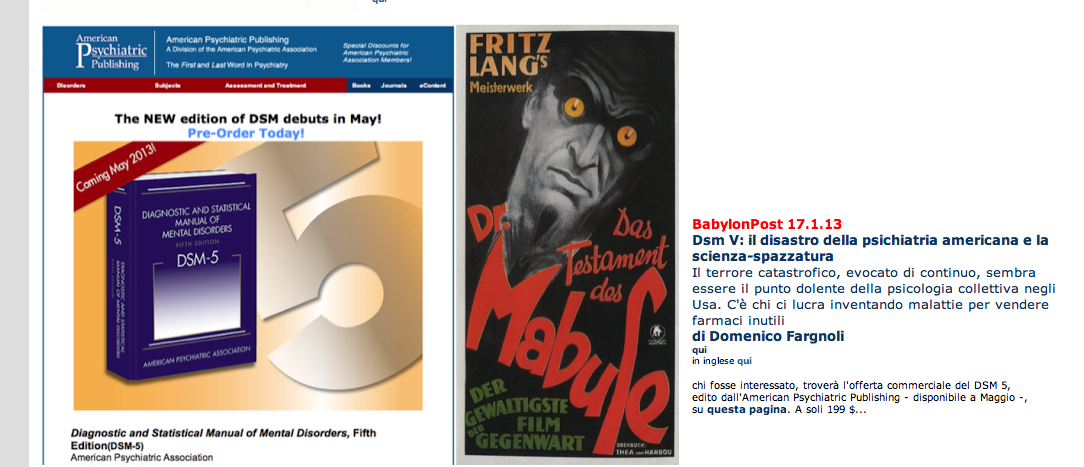


 American psychiatry is absolutely unable to face extremely serious psychotic situations such as Adam Lanza’s mass murdering: in this case schizophrenia hasn’t been diagnosed and aptly treated. A normal and physiological state of grief is considered pathologic and a clear psychotic state isn’t detected. The so called “mass shooting” has become almost epidemic, a sort of unconsciously repeated dramatization of the idea of a violent and hyper rational society (62.000 deaths in just a few years by firearms) that historically has been erected on racism and systematic extermination of native populations. The same war ideology that makes the United States so present in many unfair and useless conflicts, is the origin of a psychiatric emergency in the armed forces: 295 soldiers took their lives just in 2012. The only given response to this dramatic situation is a manual that’s been created with the aim of reinforcing the academic status quo, that is very far from real life and whose main interest is to obtain an economic profit for pharmaceutical sector. According to Frances the motivations that lead to the new edition of the DSM aren’t just of economic nature, tied to a very simple conflict of interests among various researchers paid by different pharmaceutical industries; this conflict, for the scientist, is a lot more of “intellectual” nature: these highly specialized researchers have the natural tendency to value their personal guidelines and ideas, to expand their sectors of study regardless of the practical clinical consequences for the unfortunate patients. It must not be underestimated that A.P.A. invested 25 millions in DSMV, and given that the previous edition has been a worldwide bestseller, a similar result is expected for this new edition as well, not only in terms of profits from the sells, but also in terms of increased popularity and prestige for the researchers – popularity and prestige that can be cashed in on as well. Even if Professor Frances’ critiques appear to be somehow well motivated, they do not decrease his personal responsibility in this announced disaster.





 Domenico Fargnoli
Devi effettuare l'accesso per postare un commento.